☰
🛕 Lord Vishnu | 📍 Srirangam, Tiruchirappalli, Tamil Nadu
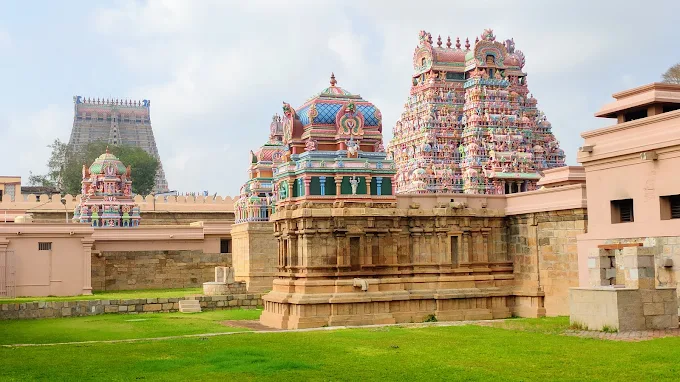
Sri Ranganathaswamy Temple in Srirangam is celebrated as the foremost of the 108 Divya Desams—the sacred abodes of Lord Vishnu praised in the Tamil devotional hymns of the Alvars (Nalayira Divya Prabandham). Known traditionally as 'Bhooloka Vaikuntam' (heaven on earth), it is considered the supreme center of Sri Vaishnavite philosophy and theology. The temple is unique because it is one of the eight self-manifested shrines ('Swayamvyakta Kshetras') of Lord Vishnu, where the deity is worshipped as Sri Ranganatha, reclining in the 'Bhujanga Sayanam' pose atop the celestial serpent Adisesha, facing south toward Sri Lanka under the golden Pranavakara Vimana.
Covering an immense expanse of approximately 156 acres (63 hectares) on an island formed by the sacred Cauvery and Kollidam rivers, Srirangam is regarded as the largest functioning Hindu temple complex in the world. The architecture exemplifies the classic Dravidian style, characterized by a unique 'Sapta-Prakara' layout consisting of seven concentric rectangular enclosures with massive granite rampart walls totaling over six miles in length. The complex is punctuated by 21 sculpted gopurams (gateway towers), chief among which is the towering southern Rajagopuram, rising to approximately 236 feet (72 meters) as one of the tallest religious structures in Asia. In addition to the principal sanctum, the complex houses nearly 50 sub-shrines dedicated to Sri Ranganayaki Thayar, Chakrathazhwar, Dhanvantari, Rama, Krishna, Narasimha, and revered Alvar saints and Acharyas. The temple is also internationally recognized for its living heritage, having received a UNESCO Asia-Pacific Award for Cultural Heritage Conservation in 2017.
The origin of Sri Ranganathaswamy Temple blends sacred devotional lore with extensive epigraphical and architectural evidence spanning over a millennium.
Traditional Beliefs:
According to the temple's Sthala Purana and Sri Vaishnava tradition, the sacred idol of Sri Ranganatha emerged spontaneously during Brahma's cosmic penance. Brahma worshipped the icon in Satya Yuga, after which it was handed down to King Ikshvaku of the Solar Dynasty and revered for generations by the kings of Ayodhya, including Lord Rama. Following his coronation after defeating Ravana, Lord Rama gifted the sacred Vimana to King Vibhishana of Lanka in gratitude for his devotion. When Vibhishana was carrying it south to Lanka, he rested the idol near the banks of the sacred River Kaveri. When he attempted to lift it again, the deity refused to move, expressing a wish to remain permanently on the island of Srirangam while benevolently turning His face south toward Lanka to bless Vibhishana and his kingdom. The early Chola king Dharmavarma subsequently consecrated the original shrine around the holy deity.
Recorded History:
Historical records and archaeological evidence establish Srirangam as an epicenter of imperial patronage from at least the 9th–10th century CE. More than 640 stone inscriptions survive on temple walls, providing valuable chronological insight into the Chola, Pandya, Hoysala, and Vijayanagara dynasties:
- Chola Dynasty: The early Cholas, notably Parantaka I (reigned 907–955 CE), Rajaraja Chola I, and Kulottunga I, endowed large tracts of fertile agricultural land, gold, and built initial granite sanctum structures.
- Pandya & Hoysala Eras: Jatavarman Sundara Pandya I (13th century) gilded the sanctum dome and vimanam with gold and dedicated grand jewels. During Hoysala intervention in the Tamil country, King Vira Someshwara established a royal military residence nearby and contributed significantly to the shrines.
- Sultanate Invasions (14th Century): In 1311 and 1323 CE, the temple suffered devastating military incursions led by Malik Kafur and later Ulugh Khan (Muhammad bin Tughluq). Foreseeing the peril, acharyas led by Pillai Lokacharya evacuated the processional icon (Namperumal) to safety across south India, eventually securing it at Tirumala (Tirupati) for nearly six decades. The philosopher-saint Swami Vedanta Desika miraculously safeguarded irreplaceable sacred manuscripts (such as the Srutaprakasika) amidst the slaughter of thousands of defenders.
- Restoration: In 1371 CE, Prince Kumara Kampana and chieftain Gopana of the Vijayanagara Empire reconquered Srirangam, reinstated Sri Namperumal in the sanctum, and restored worship. The Vijayanagara emperors and later Nayak rulers of Madurai added magnificent pillared halls (such as the Thousand-Pillar Mandapam and Sesharayar Mandapam with rampant steeds) and multiple towering gateways.
- Ramanuja's Legacy: In the 11th–12th century, the great philosopher-reformer Sri Ramanujacharya spent decades in Srirangam streamlining the temple's daily administration ('Kovil Ozhugu'), creating 10 administrative bodies (Kottus) and 72 offices (Niyogams) ensuring inclusive participation. His mortal remains ('Thaan-ana Thirumeni') are uniquely preserved within a shrine in the fifth prakaram.
- The southern Rajagopuram remained incomplete ('Mottai Gopuram') for centuries until the 44th Jeeyar of Sri Ahobila Math completed its construction in March 1987.
According to ancient Sri Vaishnavite faith, Srirangam is regarded as Bhooloka Vaikuntam. Worshipping Lord Ranganatha or passing through the sacred Paramapada Vaasal during Vaikunta Ekadashi is believed to grant liberation from the cycle of birth and rebirth.
The presence of a separate shrine dedicated to Lord Dhanvantari—the divine physician of the cosmos—is a rare feature in Hindu temples. Devotees offer prayers here and consume the sanctified herbal decoction (Kashayam) believing it restores physical well-being and longevity.
Devotional belief holds that visiting the shrine of Sri Ranganayaki Thayar, reverently known as 'Padi Thandatha Pathini' (the goddess who never steps beyond her threshold), bestows prosperity, marital happiness, and the resolution of familial discord.
Praying at the historic shrine of Sri Chakrathazhwar (Sudarshana), which depicts Lord Narasimha on the reverse, is traditionally believed to ward off evil spirits, overcome fears, and alleviate severe planetary afflictions.
Paying homage at the preserved mortal shrine of Sri Ramanujacharya (Thaan-ana Thirumeni) and the shrine of Swami Vedanta Desika is believed by devotees to grant deep spiritual clarity, intellectual eloquence, and humility.
Special ticketed morning entry enabling devotees to obtain early dawn darshan of Sri Ranganatha as the sanctum doors open at dawn.
Expedited special entry queue administered by TNHR&CE providing faster access toward the inner sanctum and the Ranga Vimana.
Personalized ritual offering involving the chanting of the 1,000 sacred names of Lord Vishnu with holy tulasi leaves and flowers on behalf of the devotee.
Sacred ceremonial ablution performed with holy water, cow's milk, curd, honey, turmeric, and sandalwood paste for the processional deity (Sri Namperumal) and Sri Ranganayaki Thayar on designated star days.
An evening ceremonial ritual in which the processional deity is gently swung on an ornate, flower-decked swing while priests chant devotional lullabies and stotras.
No festivals available.
📍 2.01 km away
📍 2.20 km away
📍 3.93 km away
📍 4.03 km away
📍 4.10 km away
Stays near Srirangam Sri Ranganathaswamy Temple

📍 Near Kurinji Andavar Temple · 148.4 km
stayStarting from ₹2,000 / night
Discover more temples you may be interested in
You may also like these temples