☰
🛕 Lord Shiva | 📍 Tenkasi, Tenkasi, Tamil Nadu
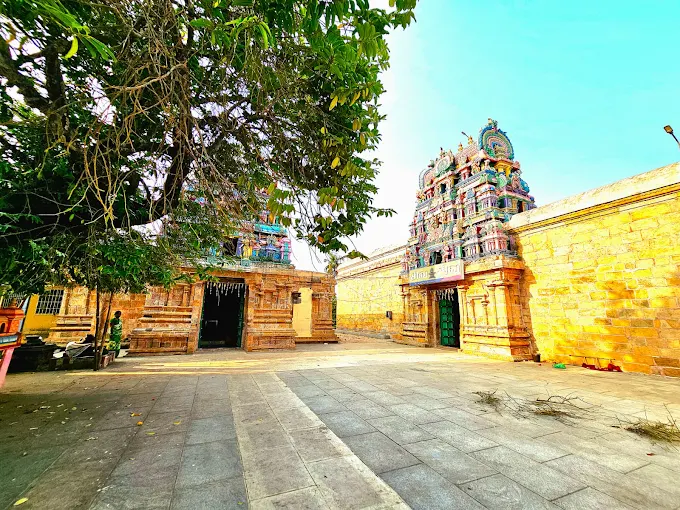
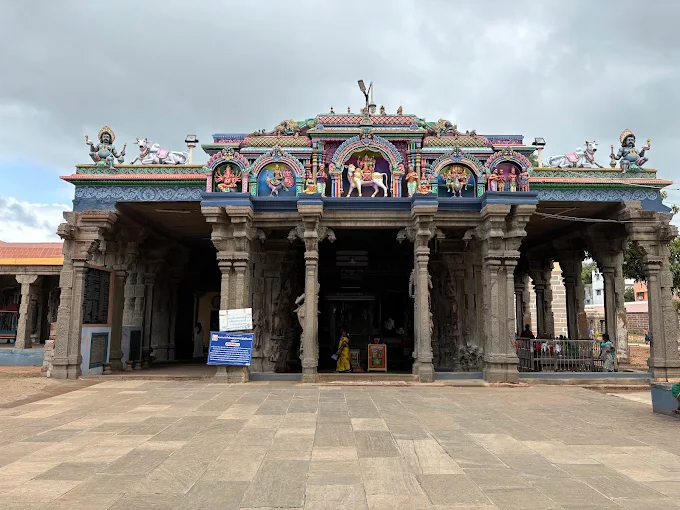
Arulmigu Kasi Viswanathar Temple in Tenkasi, Tamil Nadu, is one of the most prominent Shaivite shrines in southern India. Revered as 'Dakshina Kasi' (the Kashi of the South), it gives the town of Tenkasi ('Then Kasi' meaning Southern Varanasi) its name and identity. According to traditional belief, worshipping Lord Shiva here confers spiritual merits equivalent to visiting the venerable Jyotirlinga at Varanasi in northern India. The presiding deity is worshipped as a swayambhu (self-manifested) lingam facing east, flanked by His divine consort Goddess Parvati, who is enshrined as Goddess Ulagamman (Ulaganatha Nayaki, signifying the Mother of the Universe). Enshrined between the shrines of Lord Viswanathar and Goddess Ulagamman is Lord Bala Murugan, embodying the revered Somaskanda posture. A distinctive architectural and visual feature of the temple is its axial alignment, which allows devotees to view the sanctum and the presiding deity from as far as one kilometre outside the gopuram entrance. The holy Chittar River flowing through the town is sanctified in regional lore as the local equivalent of the River Ganga. The temple is renowned for its grand 180-foot, 9-tiered Rajagopuram—one of the tallest temple towers in Tamil Nadu—as well as its exceptional monolithic stone sculptures and musical pillars in the front mandapams that produce distinct musical notes when tapped. Unlike typical Shaivite shrines where Goddess Durga faces north or south, the Durga shrine here uniquely faces west.
The recorded history of Kasi Viswanathar Temple is deeply intertwined with the Later Pandya dynasty. Stone epigraphs preserved within the temple walls establish that the temple was founded and constructed by King Harikesari Parakrama Pandya (reigned c. 1422–1463 CE), who made Tenkasi the capital of his royal house. According to historical inscriptions and royal chronicles, King Parakrama Pandya, an ardent devotee of Lord Shiva, longed to undertake the arduous pilgrimage across northern India to Kashi (Varanasi) to bring a sacred lingam for consecration. Religious tradition holds that Lord Shiva appeared in the king's dream, explaining that traveling through war-torn northern territories was difficult and instead commanded him to build a temple in the south. The king was instructed to follow a march of ants; where the ants gathered into a termite hill on the banks of the Chittar River, the king unearthed a self-manifested lingam and initiated temple construction in 1445 CE. Construction of the magnificent sanctum, pillared mandapams, and the lower tiers of the Rajagopuram progressed during Parakrama Pandya's reign and was completed by his successor Kulasekara Pandyan (Perumal Valudi) around 1505 CE. Further architectural enhancements were added under the Madurai Nayak rulers during the 16th and 17th centuries. In 1824 CE, a catastrophic fire caused by a lightning strike severely ravaged the 180-foot Rajagopuram, leaving only the stone base intact for over a century. In 1966, an ambitious reconstruction project commenced under the aegis of the Tamil Nadu Government and local philanthropists; the nine-tiered tower was meticulously reconstructed in historic Dravidian style and grandly consecrated with a Maha Kumbhabhishekam in 1990. The temple is presently managed by the Hindu Religious and Charitable Endowments (HR&CE) Department of Tamil Nadu.
According to traditional belief, worshipping Lord Kasi Viswanathar in Tenkasi bestows the same spiritual merit and liberation (moksha) as undertaking the holy pilgrimage to Varanasi.
Devotees traditionally believe that offering prayers in the serene pillared halls and circumambulating the sanctum dispels depression, mental distress, and negative thoughts.
Special worship at the shrine of Goddess Ulagamman is traditionally performed by women and couples praying for the removal of marriage obstacles and harmonious family life.
Devotional tradition maintains that taking a sacred dip in the nearby holy waters and offering abhishekham to Lord Shiva relieves individuals of generational curses and sins.
Special comprehensive pooja service performed at the sanctum sanctorum of Lord Kasi Viswanathar on behalf of the sponsoring devotee.
Dedicated special pooja and archana conducted at the separate sanctum of Goddess Ulagamman.
Dedicated special pooja and aradhana conducted at the central shrine of Lord Bala Murugan.
Devotional ritual offering of sacred golden garment alankaram to the Goddess.
Traditional sacred bathing ritual of the deity using holy water, milk, and prescribed sacred offerings.
Chanting of the thousand divine names of the Lord or Mother Goddess by the temple priests for personal blessings.
Standard individual or family name archana offered with betel leaves, coconut, and flowers.
The primary annual Brahmotsavam of the temple, celebrated over 10 to 11 days during the Tamil month of Maasi. It commences with ceremonial flag hoisting (Dhwajarohanam) and feature...
A prominent 10-day annual festival celebrated during the Tamil month of Aippasi, focused around Goddess Ulagamman. The festival begins with flag hoisting at the Amman shrine, follo...
An annual float festival conducted on the auspicious Moolam nakshatra during the Tamil month of Aavani. Processional idols of the deities are taken out in an elaborate procession t...
Celebrated on the New Moon day (Amavasya) of the Tamil month of Thai. Unlike usual visiting hours, the temple remains open throughout the day for continuous darshan. Devotees light...
A nine-night festival celebrated in the Tamil month of Purattasi dedicated to Goddess Ulagamman. The shrine displays elaborate kolu arrangements, and special alankarams (devotional...
Observed on the Thiruvathirai (Arudra) nakshatra during the Tamil month of Margazhi. The festival honors Lord Shiva in his cosmic dance form (Nataraja) with extended maha abhisheka...
The Iypasi Thirukalyana Festival is one of the premier annual festivals celebrated at the Kasi Viswanathar Temple in Tenkasi, formally recorded by the Tenkasi District Administrati...
Celebrated on the New Moon (Amavasai) day in the Tamil month of Thai (January–February), the Bhadra Deepa Festival is an annual celebration specific to the temple. Unlike standard...
Observed over nine nights during the Tamil month of Purattasi (September–October), the Navarathri festival at Tenkasi Kasi Viswanathar Temple focuses on Goddess Ulagamman. The fest...
The Maasi Maha Festival is the most prominent annual Brahmotsavam celebrated at the Kasi Viswanathar Temple, as officially designated by the Tenkasi District Administration. Histor...
The Aavani Moolam Theppa Festival is one of the three principal cultural festivals officially recorded by the Tenkasi District Administration for this temple. Observed in the Tamil...
📍 57.46 km away
📍 66.18 km away

📍 69.17 km away
📍 90.67 km away
📍 90.84 km away
📍 91.89 km away
Stays near Kasi Viswanathar Temple, Tenkasi

📍 Near Kurinji Andavar Temple · 144.0 km
stayStarting from ₹2,000 / night
Discover more temples you may be interested in
You may also like these temples