☰
🛕 Lord Devi | 📍 Pahalgam, Anantnag, Jammu and Kashmir
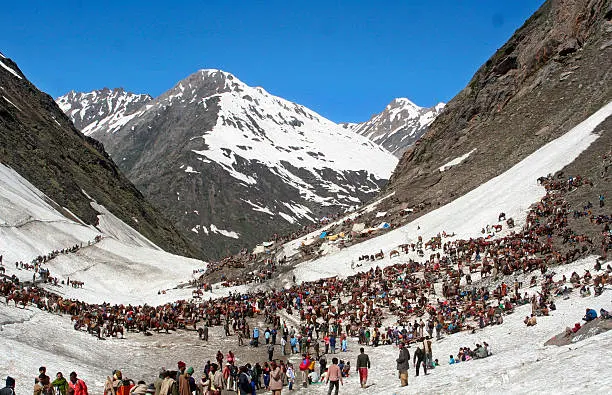
Amarnath Mahamaya Shakti Peetha is one of the revered 51 Shakti Peethas in Sanatana Dharma, nestled in the holy Amarnath Cave in the high Himalayas of Jammu and Kashmir at an altitude of approximately 3,888 metres (12,756 feet). According to classical Shakta traditions and texts such as the Devi Bhagavata Purana and Peetha Nirnaya, it marks the sacred spot where the throat (Kanth or Gala) of Goddess Sati fell after her mortal body was severed by Lord Vishnu's Sudarshana Chakra to pacify the grief-stricken cosmic dance of Lord Shiva. In this peetha, the Divine Mother is venerated in the form of Goddess Mahamaya, while Lord Shiva presides as the protector Bhairava named Trisandhyeshwar.
The cave is renowned worldwide for its naturally occurring svayambhu ice stalagmite formation of Lord Shiva (popularly hailed as Baba Barfani), which waxes and wanes with the phases of the moon. Alongside the main ice Lingam, smaller natural ice formations representing Goddess Parvati (Mahamaya) and Lord Ganesha manifest each summer. The spiritual significance of this shrine is intrinsically linked to the eternal 'Amar Katha' (the cosmic secret of immortality and divine creation), which Lord Shiva narrated to Goddess Parvati in absolute seclusion, ensuring no living creature could overhear it. Devotees believe that worshipping Goddess Mahamaya and Lord Trisandhyeshwar within the sacred cave dissolves deep karmic entanglements, lifts the cosmic veil of spiritual illusion (maya), and bestows the supreme state of liberation (moksha).
The history of the Amarnath cave and its sanctum spans ancient scriptures, medieval chronicles, and modern administrative records. Historically and traditionally, mentions of the cave are found in ancient Sanskrit literature including the Nilamata Purana and Kalhana's 12th-century historical chronicle, the Rajatarangini. In the Rajatarangini, the shrine is referred to as 'Amareshwara', and it records that King Samdhimat (Aryaraja) of Kashmir (around 34 BCE according to local dynastic chronology) visited the shrine, and Queen Suryamati gifted sacred banners and trident offerings to the sanctuary in the 11th century. Foreign travellers such as the French physician François Bernier, who accompanied Emperor Aurangzeb to Kashmir in 1663, documented the renowned cave of iced stalagmites in his travelogues.
According to popular folklore, the forgotten cave was rediscovered in the modern era around the middle of the 19th century by a local Gujjar shepherd named Buta Malik, who received a bag of coal from a wandering ascetic that miraculously turned into gold; upon returning to thank the sage, he discovered the sacred ice sanctum. For generations, descendants of the Malik family and Hindu priests jointly maintained the offerings until modern restructuring.
In 2000, the Jammu and Kashmir State Legislature enacted the Jammu and Kashmir Shri Amarnath Ji Shrine Act, which established the Shri Amarnathji Shrine Board (SASB), chaired by the Lieutenant Governor of Jammu and Kashmir. The SASB comprehensively oversees the pilgrimage management, safety, infrastructure, route security, and traditional pujas during the annual summer pilgrimage window (Amarnath Yatra).
Devotional tradition holds that worshipping Goddess Mahamaya at the throat peetha removes spiritual ignorance, cuts through worldly illusions, and awakens pure wisdom.
Pilgrims believe that visiting the sanctum where Lord Shiva expounded the secret Amar Katha bestows the blessing of immortality of the soul and freedom from the cycle of rebirth.
Undertaking the arduous Himalayan trek amidst snow and severe cold is traditionally considered an act of great penance (tapasya) that washes away past karmic imprints.
The presence of both the svayambhu ice Lingam of Lord Shiva and the Mahamaya Shakti formation grants the devotee the integrated grace of cosmic consciousness and creative energy.
The ceremonial inaugural puja conducted on the auspicious occasion of Jyeshtha Purnima by the Shri Amarnathji Shrine Board authorities and Vedic scholars at the holy cave, officially inaugurating the spiritual proceedings of the Yatra.
An official service organized by the Shri Amarnathji Shrine Board for devotees across the globe who are unable to physically undertake the trek, where cave priests perform dedicated sankalp puja in the devotee's name and gotra.
A sacred Vedic fire ritual performed by the shrine priests in the name of the registered devotee at the cave shrine for health, prosperity, and spiritual liberation.
The centuries-old traditional culmination ceremony on Shravan Purnima (Raksha Bandhan), where the sacred mace of Lord Shiva (Chhari Mubarak) arrives from Dashnami Akhara at the holy cave, concluding the annual pilgrimage.
The annual pilgrimage to the holy Amarnath Cave, which enshrines the Mahamaya Shakti Peetha along with the swayambhu ice Lingam. According to Hindu tradition, this cave is the site...
The ceremonial procession of the holy mace (Chhari Mubarak) of Lord Shiva and Devi, traditionally carried from Dashnami Akhara in Srinagar to the Amarnath Cave. Led by its designat...
The ceremonial inaugural worship performed by the Shri Amarnathji Shrine Board (SASB) to invoke divine blessings for a successful and safe yatra season. The ritual is observed on t...
📍 141.42 km away
📍 160.04 km away
📍 160.12 km away
📍 245.61 km away
📍 271.21 km away
📍 319.50 km away
Stays near Amarnath Mahamaya Shakti Peetha

📍 Near Kurinji Andavar Temple · 2,673.7 km
stayStarting from ₹2,000 / night
Discover more temples you may be interested in
You may also like these temples