☰
🛕 Lord Shiva | 📍 Kanchipuram, Kanchipuram, Tamil Nadu
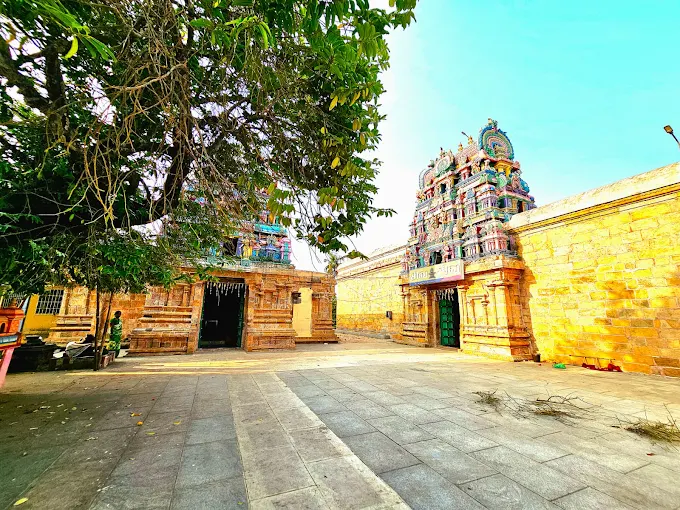
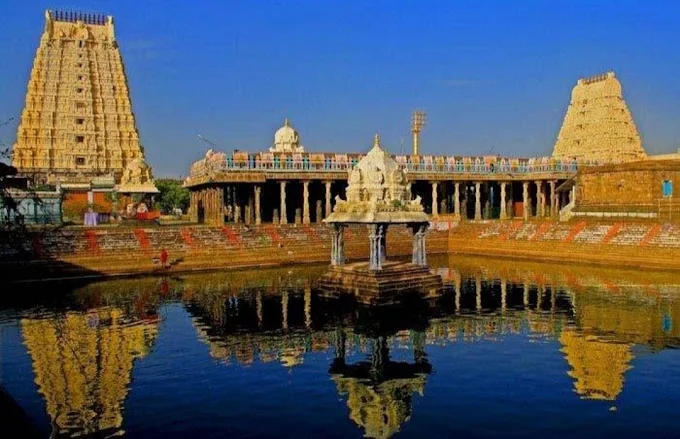
Arulmigu Ekambareswarar Temple in Kanchipuram is one of the most revered and ancient Saivite sanctuaries in South India, celebrated as the 'Prithvi Sthalam' (Earth Element) among the sacred Pancha Bhoota Sthalams. Here, Lord Shiva is enshrined as Ekambaranathar in the form of a 'Prithvi Lingam'—traditionally believed to have been molded out of sacred river sand by Goddess Parvati (worshipped here as Elavarkuzhali Ambal) during her intense penance on the banks of the Vegavathi River. Because the sanctum Lingam is made of sand, traditional abhishekam (sacred bath) is not poured directly onto the earth lingam itself; instead, it is performed on the Avudaiyar (pedestal) and an adjacent Spatika (crystal) Lingam to preserve the sacred mud idol.
The temple is also a prominent Paadal Petra Sthalam, sanctified by the ecstatic devotional verses of the 7th-century Saiva Nayanmars—Appar, Sundarar, and Sambandar—in the Tevaram canons. Sundarar famously regained his lost vision in his left eye after singing the pathigam 'Aalam thaan ugandhamudhu seidhaanaai' at this temple. Uniquely demonstrating inter-sectarian harmony, the temple premises also enshrine the Nilathingal Thundam Perumal (dedicated to Lord Vishnu as Chandra Chooda Perumal), recognized as one of the 108 Divya Desams sung by the Vaishnava Azhwars. Within the inner prakaram stands the ancient sacred mango tree (Mavadi), traditionally held to be over 3,500 years old, whose four main branches are believed to represent the four Vedas and yield fruits of different tastes. The temple complex covers nearly 25 acres, making it one of the largest temple precincts in India.
Historically, the architectural evolution of the Ekambareswarar Temple spans over a millennium, reflecting contributions from major South Indian ruling dynasties including the Pallavas, Cholas, and Vijayanagara emperors. The original brick and stone foundation traces back to the Pallava era around the 6th to 7th centuries CE under rulers such as Mahendravarman I. Ancient Tamil texts from the late Sangam and post-Sangam periods, along with the devotional Tevaram hymns of the 7th and 8th centuries, provide indisputable evidence that a prominent Shiva sanctuary existed here well over 1,300 years ago.
During the 10th to 12th centuries CE, the imperial Chola dynasty significantly expanded the temple complex into an extensive granite edifice. Epigraphical records on the stone walls indicate substantial land endowments, renovations of corridors (prakarams), and donations of perpetual lamps and gold ornaments made during the reigns of Aditya I, Parantaka I, Rajaraja I, Rajendra Chola I, and Kulothunga III. The inner enclosures and smaller subsidiary shrines bear architectural marks of the high Chola style.
In the 16th century CE, the Vijayanagara Empire brought the temple to its monumental pinnacle. Emperor Krishnadevaraya is credited with commissioning the grand Rajagopuram (temple gateway) on the southern entrance around 1509–1516 CE. Rising to approximately 58.5 meters (192 feet) across eleven tiers, it remains one of the tallest gopurams in India. The Vijayanagara rulers also constructed the colossal Thousand Pillar Hall (Aayiram Kaal Mandapam) and the outermost fifth enclosure (prakaram). Subsequent endowments and maintenance were carried out by Nayaka chieftains and prominent merchant philanthropists like Pachaiyappa Mudaliar in the 18th and 19th centuries. Today, the heritage complex is administered by the Hindu Religious and Charitable Endowments (HR&CE) Department of the Government of Tamil Nadu.
According to traditional belief, because Goddess Parvati performed rigorous tapas here and united in divine matrimony with Lord Shiva under the mango tree, prayers offered here help remove obstacles in finding a suitable spouse and strengthen marital harmony.
Pilgrims traditionally worship at the Sahasra Lingam and the numerous stone naga idols established within the temple praharams to seek relief from Naga Dosha and planetary imbalances.
Stemming from the traditional Saivite lore of Saint Sundarar regaining his lost eyesight upon singing hymns to Lord Ekambareswarar, devotees with eye afflictions frequently pray here for healing and spiritual clarity.
As the sacred sanctuary representing the Earth element (Prithvi), worshiping here is believed in Saiva philosophy to bestow stability, material and spiritual grounding, and release from cyclic karmic entanglements.
Special abhishekam conducted at the sanctum sanctorum on the pedestal and the crystal lingam with sacred offerings including milk, curd, honey, and vibhuti.
Sacred archana performed by priests chanting the divine names of Lord Ekambareswarar while offering holy bilva leaves.
Bi-monthly evening ritual observed during the auspicious Pradosham period with grand abhishekam to Nandi and special procession of the utsavar deity.
Special individual archana performed with the recitation of the 1,000 sacred names of Lord Shiva for devotee blessings.
Panguni Brahmotsavam is the most significant annual festival of Arulmigu Ekambareswarar Temple, celebrated over 13 to 14 days in the Tamil month of Panguni. The festival reenacts t...
Aani Thirumanjanam is one of six major annual abhishekam observances dedicated to Lord Nataraja in Tamil Shaivite tradition. Celebrated under the Uthiram asterism in the Tamil mont...
Chitra Pournami is celebrated on the full moon day of the Tamil month of Chithirai. Dedicated to invoking spiritual merits and auspiciousness, the temple marks the occasion with sp...
Karthigai Deepam is an annual festival of lights celebrated in the Tamil month of Karthigai when the moon aligns with the Krittika star. According to Shaivite tradition, the day ho...
Maha Shivaratri is one of the principal annual observances at the temple, dedicated to Lord Shiva. In religious tradition, the temple is venerated as the Prithvi Sthalam (earth ele...

📍 0.81 km away
📍 0.86 km away

📍 1.22 km away
📍 2.75 km away
📍 15.45 km away
📍 16.65 km away
Stays near Kanchipuram Ekambareswarar Temple

📍 Near Kurinji Andavar Temple · 376.8 km
stayStarting from ₹2,000 / night
Discover more temples you may be interested in
You may also like these temples