☰
🛕 Lord Vishnu | 📍 Kumbakonam, Thanjavur, Tamil Nadu
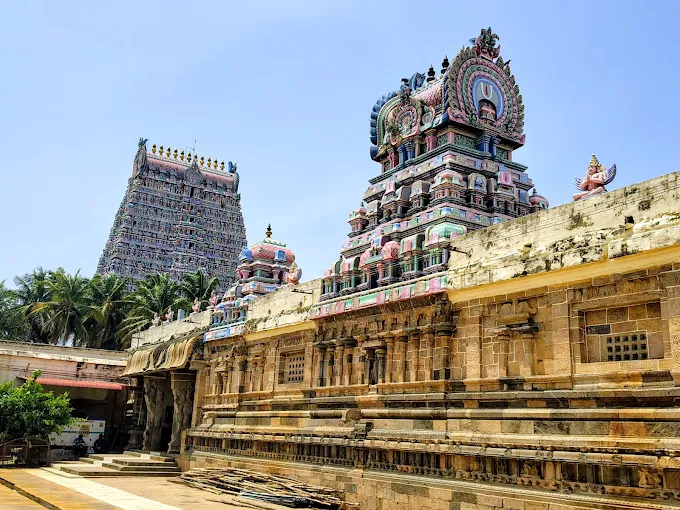
Sri Sarangapani Perumal Temple, situated in the heart of Kumbakonam between the Cauvery and Arasalar rivers, is revered as one of the holiest Vaishnavite shrines in India. In traditional Srivaishnava theology, it is celebrated as the third most prominent of the 108 Divya Desams, ranked right after Srirangam and Tirupati. It is also one of the venerated Pancharanga Kshetrams located along the Cauvery basin.
The temple holds a pre-eminent position in Tamil religious literature because of its intimate connection with the 'Nalayira Divya Prabandham'. According to traditional belief, it was hearing the hymn 'Aravamudhe Adiyen Ulam Urugai' sung by wandering devotees at this shrine that inspired acharya Sri Nathamuni to journey extensively and recover the entire canon of four thousand hymns composed by the twelve Alvars. Seven Alvars (Bhoothathalvar, Peyalvar, Nammalvar, Thirumalisai Alvar, Andal, Periyalvar, and Thirumangai Alvar) have sung verses praising Lord Sarangapani.
Architecturally and conceptually, the sanctum sanctorum (Vaideeka Vimana) is built in the form of a grand chariot (Ratha) drawn by elephants and horses, representing the Lord descending directly from Vaikuntha. The presiding deity, Lord Sarangapani (also known as Aravamudhan), rests in the rare 'Utthana Sayanam' posture—depicted as partially rising from His serpentine bed. Tradition recounts that when Thirumalisai Alvar sang 'Nadanthu Kaal Nondhavo', the Lord began to rise up to acknowledge His devotee's love; overwhelmed, the Alvar requested Him to remain in that half-rising state forever.
Another distinctive architectural and spiritual feature is the twin-entrance system to the inner sanctum: the 'Uttarayana Vasal' (opened from the Tamil month of Thai to Aani, marking the sun's northern movement) and the 'Dakshinayana Vasal' (opened from Aadi to Margazhi, marking the sun's southern course). Goddess Mahalakshmi is enshrined here as Sri Komalavalli Thayar and is reverently known as 'Padi Thaanda Pathini' (the consort who never crosses the threshold of her sanctum), meaning all utsavar processions of the Lord proceed directly to her chamber.
The history of the Sri Sarangapani Temple encompasses both documented archaeological history spanning nearly a millennium and timeless devotional traditions (Sthala Purana).
Devotional Lore & Origins (Sthala Purana):
According to Hindu tradition, Sage Bhrigu performed penance in this holy region (historically known as Thirukkudanthai) to seek Goddess Mahalakshmi as his daughter, seeking forgiveness for testing the holy trinity. Pleased by his devotion, Goddess Lakshmi incarnated from a thousand-petalled golden lotus in the Potramarai (Golden Lotus) temple tank. The sage named her Komalavalli and raised her. When she came of age, Lord Vishnu descended in a celestial chariot from Vaikuntha carrying His bow 'Saranga' to wed her, thus acquiring the name 'Sarangapani' ('He who holds the bow in His hand').
A notable temple tradition is the ritual performance of ancestral rites (shraddha) by Lord Sarangapani Himself on the day of Deepavali. According to tradition, an ardent devotee named Lakshmi Narayana Swami dedicated his entire life and wealth to the service and renovation of the temple without marrying or leaving an heir. Moved by his selfless surrender, the Lord is said to have promised to perform his annual death ceremonies, a ritual continuing every year on Deepavali amavasya.
Historical & Epigraphical Records:
Inscriptions and architectural analyses indicate that the earliest structural foundations in stone date back to the Imperial Chola era, particularly during the reigns of Vikrama Chola and Kulothunga Chola III (12th–13th centuries CE). The sanctum, designed as a ratha (chariot), exhibits fine late Chola artistic traditions.
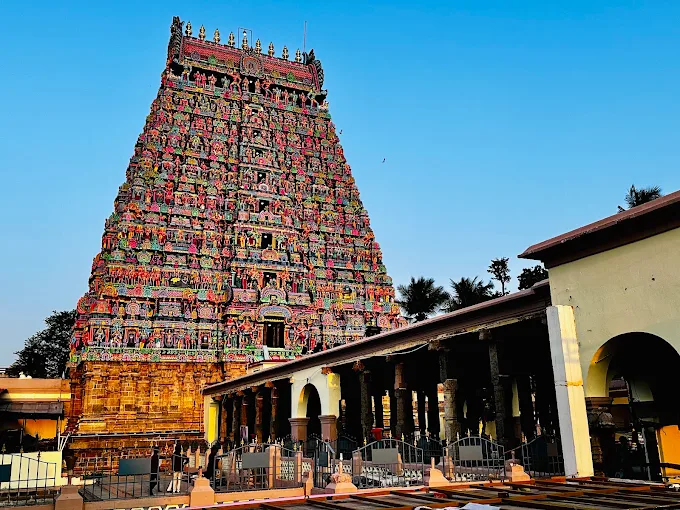
Substantial expansions occurred during the Vijayanagara Empire and under the Thanjavur Nayaks in the 16th and 17th centuries. The monumental 11-tiered eastern Rajagopuram, rising to an impressive height of over 146 feet (often cited up to 173 feet with kalasams), was heavily endowed and completed during the Nayak era, displaying elaborate sculptural depictions of Bharatanatyam karanas, mythological sequences, and celestial figures. The pillared halls, including the hundred-pillar hall and the Achyutha Bhupala mandapa, were constructed by the Nayak rulers. Today, the temple is protected, maintained, and administered under the Hindu Religious and Charitable Endowments (HR&CE) Department of the Government of Tamil Nadu.
Devotees traditionally believe that worshipping Lord Aravamudhan in His Utthana Sayana posture bestows spiritual upliftment, inner peace, and divine liberation (moksha), being one of the holiest Divya Desams.
Praying at the sannidhi of Sri Komalavalli Thayar is traditionally believed to remove obstacles in finding a life partner and to nurture lasting affection and unity between husband and wife.
Because the presiding deity Himself performs annual rites (shraddha) for His devotee Lakshmi Narayana Swami, praying here is traditionally held to invoke the blessings of ancestors and alleviate ancestral afflictions.
Connecting with Thirumalisai Alvar's verse asking whether the Lord's legs pained from walking, devotees traditionally pray here to gain relief from chronic exhaustion, bodily ailments, and joint pains.
Circumambulating the chariot-shaped sanctum and taking a holy dip in the sacred Potramarai tank is traditionally believed to ward off severe doshas and shield families from unexpected adversities.
Chanting of the thousand divine names of Lord Sarangapani / Goddess Komalavalli Thayar with holy tulasi and flowers; booked directly at the temple counter.
Special ceremonial sacred bath (abhishekam) performed for the utsavar idol of Goddess Sri Komalavalli Thayar with milk, curd, honey, and sanctified water on auspicious Fridays and Nakshatra days.
A unique annual ritual performed on Deepavali day where Lord Sarangapani Himself symbolically performs the ancestral rites for His ardent devotee Lakshmi Narayana Swami.
Devotional enactment of the celestial wedding of Lord Sarangapani and Goddess Komalavalli Thayar, conducted on request by devotees seeking marital bliss.
No festivals available.
📍 0.11 km away

📍 0.19 km away

📍 0.32 km away
📍 0.55 km away

📍 0.78 km away

📍 1.53 km away
Stays near Kumbakonam Sarangapani Perumal Temple

📍 Near Kurinji Andavar Temple · 221.1 km
stayStarting from ₹2,000 / night
Discover more temples you may be interested in
You may also like these temples